The Cost of Abstraction: Lessons in High-Performance Systems

Brian Mutai
Full-Stack Engineer
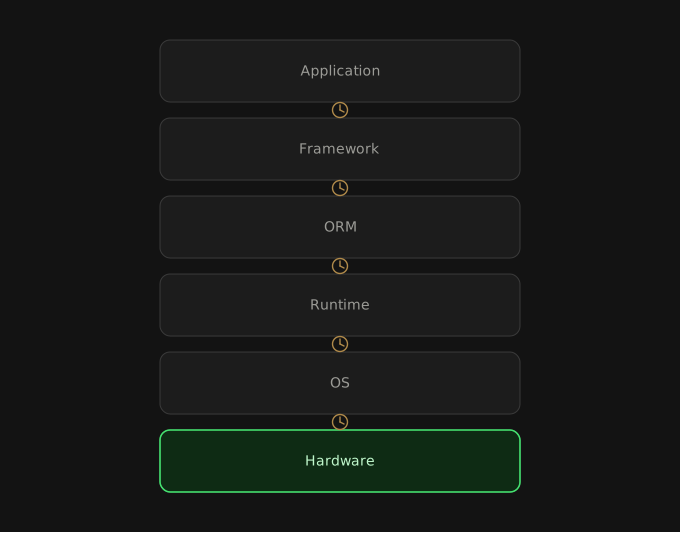
Every layer of software we add between hardware and intent comes with a tax.
In the pursuit of developer velocity, we embraced high-level abstractions that shield us from silicon realities: garbage collectors that manage memory, ORMs that translate between objects and rows, HTTP frameworks that handle the protocol machinery. For most applications, these shields are the right call. They reduce bugs, accelerate delivery, and make systems accessible to larger teams.
For high-performance systems, they can become shackles.
The goal of this piece is not to argue against abstractions. It is to argue for understanding their cost model so that when you are operating at a level where the tax matters, you know exactly what you are paying, and when to stop paying it.
What Abstractions Actually Hide
Abstractions hide complexity. That is their purpose. The question is what kind of complexity they hide, and whether hiding it is always the right call.
Consider a garbage-collected language. The abstraction hides manual memory management: a large category of bugs involving use-after-free, double-free, and memory leaks. This is enormously valuable for most applications. The tax is non-deterministic pause times. When the GC runs a collection cycle, execution pauses. In a web service with a p99 SLA of 100ms, a 50ms stop-the-world pause is visible and painful. In a high-frequency trading engine where microseconds matter, it is a system failure.
The abstraction made a good tradeoff for general-purpose applications and a bad tradeoff for latency-critical ones. The abstraction didn't change; the requirements did.
The same pattern appears everywhere:
- HTTP/2 multiplexing hides TCP connection management, at the cost of head-of-line blocking when packet loss occurs on a connection shared by multiple streams.
- ORMs hide SQL generation, at the cost of N+1 queries when you access a relationship on every item in a list.
- Serverless functions hide server management, at the cost of cold-start latency during traffic spikes.
- Kubernetes hides infrastructure orchestration, at the cost of a steep operational learning curve and network overhead that matters for low-latency inter-service calls.
None of these are wrong. They are tradeoffs. The engineers who struggle are those who cannot articulate what the tradeoff is, and therefore cannot reason about when it matters.
Memory, Cache, and the Invisible Hierarchy
The performance gap between CPU cache and main memory is approximately 100x. The gap between L1 cache and a network-accessible database is approximately 1,000,000x.
Most developers reason about computation as if all memory access has uniform cost. It does not. The CPU cache hierarchy is the most important performance primitive that high-level abstractions hide most completely.
A function that processes an array sequentially is cache-friendly; the hardware prefetcher loads upcoming elements before they are needed. A function that dereferences pointers in an object graph is not cache-friendly; each dereference is potentially a cache miss, and the prefetcher cannot help when access patterns are unpredictable.
This is why data-oriented design exists as a discipline. It argues for organizing data by how it is accessed, not by how it maps to conceptual domain objects. Instead of an array of Player objects where each Player has position, velocity, and health fields, you maintain three separate arrays: one for positions, one for velocities, one for health values. Processing all positions operates on contiguous memory. The CPU cache is happy.
In the object-oriented layout, iterating over all positions loads the entire Player struct into cache, including velocity, health, name, and all other fields, even though the batch operation only needs position. In the data-oriented layout, iterating over all positions loads only positions into cache. The working set is smaller, cache utilization is higher, and throughput is higher by a factor of 2-10x for batch operations.
When to Reach Through the Abstraction
The discipline is not in knowing how to bypass abstractions. It is in knowing when bypassing them is warranted, which requires measuring, not intuiting.
The prerequisite for any low-level optimization is a profiler. Not guessing. Not intuition about where the bottleneck is. Measurement.
A Rust application using unsafe for zero-copy I/O is justifiable when profiling shows that allocation is the bottleneck. A Java application using direct ByteBuffers to avoid garbage collection pressure is justifiable when profiling shows GC pause times in the latency tail. The same techniques applied without profiling data are premature optimization, and premature optimization has the same result as any other form of technical debt: it makes the system harder to understand and maintain without a guaranteed performance return.
The comment matters here. unsafe in Rust is a marker that says: the compiler's safety guarantees no longer apply in this block. That is a significant claim. The comment documents why the safety guarantee was worth bypassing: profiling evidence, not intuition.
The N+1 Problem as Abstraction Tax
One of the most common performance problems in web applications is the N+1 query, and it is almost entirely a product of ORM abstraction.
The ORM makes it natural to write:
The developer wrote one loop. The ORM issued N+1 queries: one to fetch all posts, and one for each post to fetch its author. At 100 posts, this is 101 queries. At 10,000 posts, this is 10,001 queries.
The fix (select_related or prefetch_related in Django, eager loading in ActiveRecord, include in various ORMs) requires the developer to reason about the query plan their ORM will generate, which is exactly the low-level detail the ORM was designed to abstract away.
This is the abstraction tax in practice: the abstraction works perfectly until you need to understand what it is actually doing, at which point you must understand both the abstraction and the underlying system simultaneously. This is often harder than understanding the underlying system directly.
The engineers who are most effective with ORMs are those who understand SQL well enough to predict what queries their ORM will generate, and verify it with query logging. They are using the abstraction as a productivity tool while retaining the underlying mental model.
The Kubernetes Example
Kubernetes is a useful lens for thinking about abstraction cost at the infrastructure layer.
Kubernetes abstracts away server management, service discovery, scaling, and deployment orchestration. For organizations with large engineering teams and complex microservice deployments, this abstraction is enormously valuable. For a two-person startup deploying a monolith to three servers, it is a significant operational burden with no proportional benefit.
The Kubernetes tax includes: a steep learning curve (certified Kubernetes administrator certifications exist because the operational depth is real), additional network hops through kube-proxy and service mesh for inter-service calls, resource overhead from the control plane components, and increased debugging complexity when pods misbehave in ways that require understanding scheduler behavior, affinity rules, and networking primitives.
None of this makes Kubernetes wrong. It makes Kubernetes the wrong tool for applications that do not need what it provides. The engineers who are effective with Kubernetes are those who understood its cost before they chose it, not those who chose it because it was the default for "serious" infrastructure.
The Pragmatic Principle
High-performance engineering is not about avoiding abstractions. It is about applying them where their tradeoffs are favorable, and bypassing them, with evidence, where they are not.
A useful heuristic: an abstraction is appropriate when the cost it imposes is smaller than the cost it prevents. The cost it imposes is measurable (latency, memory, CPU, operational complexity). The cost it prevents is often theoretical (bugs you didn't write, complexity you didn't have to manage). When you cannot measure the cost of the abstraction, you cannot make a principled decision about whether to bypass it.
The sequence that produces good outcomes:
- Use the highest-level abstraction that is likely to satisfy requirements.
- Measure, under realistic load, whether requirements are being met.
- Profile to identify where the actual bottleneck is.
- Bypass or replace the abstraction at the bottleneck, with documentation explaining why.
- Measure again to confirm the improvement.
Step three is the one that teams most often skip, moving from "requirements not met" directly to "rewrite in Rust." The profiler is not an optional tool. It is the instrument that makes the difference between optimization and guessing.
Great engineering is the pragmatic middle: as high-level as possible, as low-level as necessary. The discipline is in maintaining the clarity to tell them apart.