Postgres Is Still the Right Answer in 2026

Brian Mutai
Full-Stack Engineer
Every couple of years, a wave of new databases emerges, each one promising to solve the problems that Postgres supposedly cannot. In 2021 it was distributed SQL. In 2023 it was vector databases. In 2025 it was multi-modal stores that handle text, embeddings, and graph traversals in a single query.
Postgres keeps absorbing them.
This is not a nostalgic defense of an old technology. It is an engineering argument: for the overwhelming majority of applications built in 2026, PostgreSQL is the right starting point, and a significant fraction of teams that reach for a specialized database too early end up carrying more operational complexity than the performance gain justifies.
What Postgres Actually Does Now
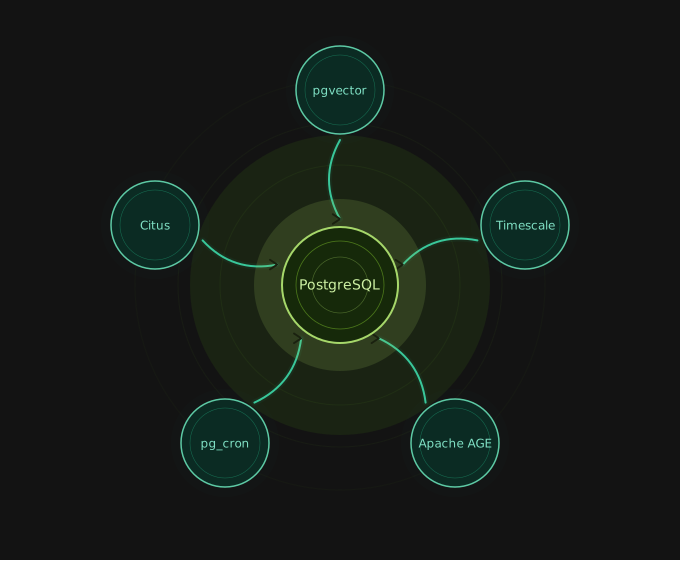
The PostgreSQL of 2026 is not the PostgreSQL of 2016. The extension ecosystem has expanded to cover use cases that required purpose-built systems only a few years ago.
pgvector stores and queries vector embeddings with support for approximate nearest-neighbor search via HNSW and IVFFlat indexes. If your application uses embeddings for semantic search, recommendation, or RAG pipelines, pgvector handles this at meaningful scale before you need a dedicated vector database.
Timescale and pg_partman handle time-series data with declarative partitioning, automated retention policies, and continuous aggregates. Telemetry, IoT streams, and metrics pipelines are well-served by Postgres extensions before you need InfluxDB or a purpose-built TSDB.
Apache AGE enables graph queries in Postgres using an openCypher-compatible syntax, giving you property graphs over your relational data without an additional operational dependency.
pg_cron runs scheduled jobs inside the database. No Celery, no external scheduler for simple periodic tasks.
The question is not whether these extensions match the theoretical performance ceiling of purpose-built alternatives. They do not, at the extreme end. The question is whether your application is operating at that extreme, and most are not.
The Real Cost of Polyglot Persistence
The case for specialized databases usually focuses on the happy path: the vector database returns results 30% faster at p99, the time-series database compresses data 40% more efficiently. These are real properties.
What the case omits is operational cost.
Every additional database type in your stack:
- Adds a connection pool to manage and tune
- Adds backup and recovery procedures to test and rehearse
- Adds an authentication surface to rotate credentials for
- Adds schema migration tooling to maintain, or builds up drift when you don't
- Adds a knowledge gap that grows every time a new engineer joins the team
- Creates data residency and compliance questions when managed by a different vendor
For a small-to-medium team, a stack with Postgres, Redis, and Elasticsearch is already three databases to operate. Adding a vector database for semantic search brings it to four. Adding a time-series store brings it to five.
At some point, the accumulated operational complexity begins to cost more than the individual performance gains justify. The teams that discover this tend to do so in the middle of an incident, not during a planning session.
The pgvector Case Study
In 2024 and 2025, vector databases became a standalone product category. Pinecone, Weaviate, Qdrant, Chroma, each offering managed or self-hosted vector search as a separate service. The use case was valid: as LLM-powered applications proliferated, storing and querying embeddings became a core requirement.
The problem teams discovered: a dedicated vector database is a third database to operate. You have your application database (Postgres), your cache (Redis), and your vector store (Pinecone). Data is split across three systems. Joins between structured data and vector search results happen at the application layer, not the query layer. Transactional guarantees across these systems require compensating logic you must write and maintain.
With pgvector, embeddings live in the same table as the entities they represent. A product search combining exact filters with semantic similarity is a single query:
This is not possible as a single operation when your vector index is in a separate database. The transactional consistency is free. The operational simplicity is significant.
For most RAG pipelines, pgvector at HNSW index precision handles hundreds of millions of vectors before recall begins to degrade noticeably. Few applications reach that scale before facing other bottlenecks first.
Migrations and the Long Game
There is a governance argument for staying on Postgres that rarely appears in database comparison posts: schema evolution.
Postgres has the most mature migration tooling of any database. Flyway, Liquibase, pgroll, golang-migrate: you can choose your migration strategy and find excellent tooling, deep documentation, and engineers who already know how to use it. Zero-downtime migrations via concurrent index creation, logical replication-based schema changes, and careful column deprecation patterns are well-understood and widely practiced.
Specialized databases often have weaker migration stories. Adding a column to your vector store's metadata schema, changing the dimensionality of embeddings when you upgrade models, or backfilling data after a schema change: these operations are often proprietary, poorly documented, or require database-specific expertise that is harder to hire for.
Over a multi-year project, migration complexity accumulates. Postgres's migration tooling and community knowledge is a genuine long-term asset.
When Postgres Is Not the Answer
This argument has real limits. There are specific scenarios where Postgres should not be the answer:
Multi-region active-active writes: If your application requires geographically distributed writes with sub-100ms local latency, Postgres's single-primary replication model does not fit. This is a genuine constraint, not a marketing distinction. CockroachDB, YugabyteDB, or DynamoDB are better fits here.
Extremely high write cardinality: Applications writing millions of rows per second, such as high-frequency financial tick data or detailed telemetry from large IoT fleets, will hit Postgres's write throughput ceiling. At that scale, Cassandra or a purpose-built time-series store is the right answer.
Deep graph traversals over billions of edges: If your core application primitive is pathfinding or relationship traversal over a billion-node graph, Apache AGE on top of Postgres will not serve you well. Neo4j or TigerGraph are better fits.
The honest calibration: most applications reach none of these limits. Postgres handles tens of thousands of writes per second, terabytes of data, and complex queries over millions of rows without special configuration. Most teams reach for specialized systems before they need to, based on expected future scale rather than measured current requirements.
Horizontal Scaling Postgres
One of the most common objections is that Postgres does not scale horizontally. This is partially true but often overstated.
Read replicas handle read-heavy workloads by routing queries to replicas. For applications where reads dominate, which is most applications, this scales read capacity significantly with straightforward configuration.
Citus extends Postgres with transparent sharding, distributing tables across nodes and executing queries in parallel. It is used in production at scale at Microsoft and various data-intensive startups.
PgBouncer or PgPool handle connection pooling, reducing the per-connection overhead that becomes a bottleneck at high concurrency before the underlying database itself is the bottleneck.
For the vast majority of teams, these options provide more scaling headroom than they will need. The argument that "Postgres doesn't scale" is usually made before the team has exhausted read replicas, connection pooling, and careful query optimization. These are steps that are cheaper and faster than a full database migration.
A Pragmatic Starting Point
The practical advice for 2026 is not "never use specialized databases." It is: start with Postgres and add a specialized system when you have measured evidence that Postgres is the bottleneck, not when you anticipate that it might be.
Extensions like pgvector, Timescale, and pg_cron push the boundary of what Postgres can handle much further than most teams realize. You should know that boundary before you add an operational dependency you will carry for years.
The database ecosystem will keep producing new categories. Most teams would be better served by going deeper on a general-purpose system they already operate well than by adopting each new category at initial release. Postgres has been absorbing specialized use cases for thirty years. That track record is worth something.